• About Me

Cycle Seattle

~ Posts on bikes

Cycle Seattle

Tag Archives: Velo Routier

Image

Trail Riding

06 Wednesday Jan 2016

Tags

a. homer hilsen, bicycle, bike, commute, Cycles Toussaint, cycling, front bag, low-trail, randonneur, rivendell, Seattle, Velo Routier


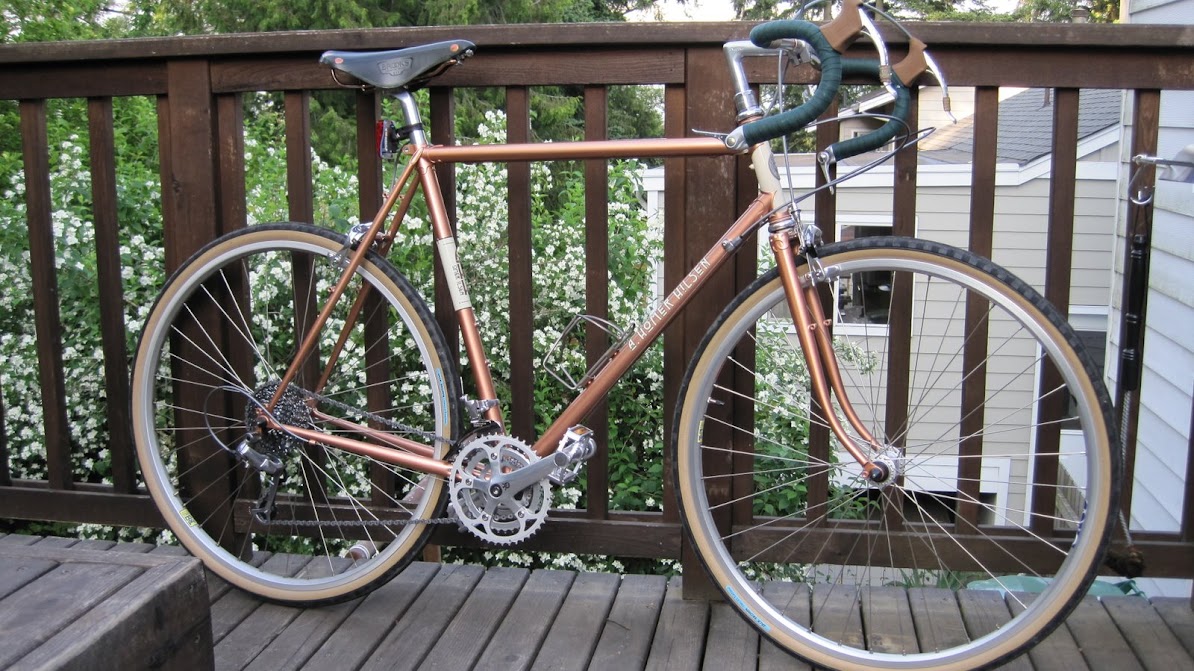
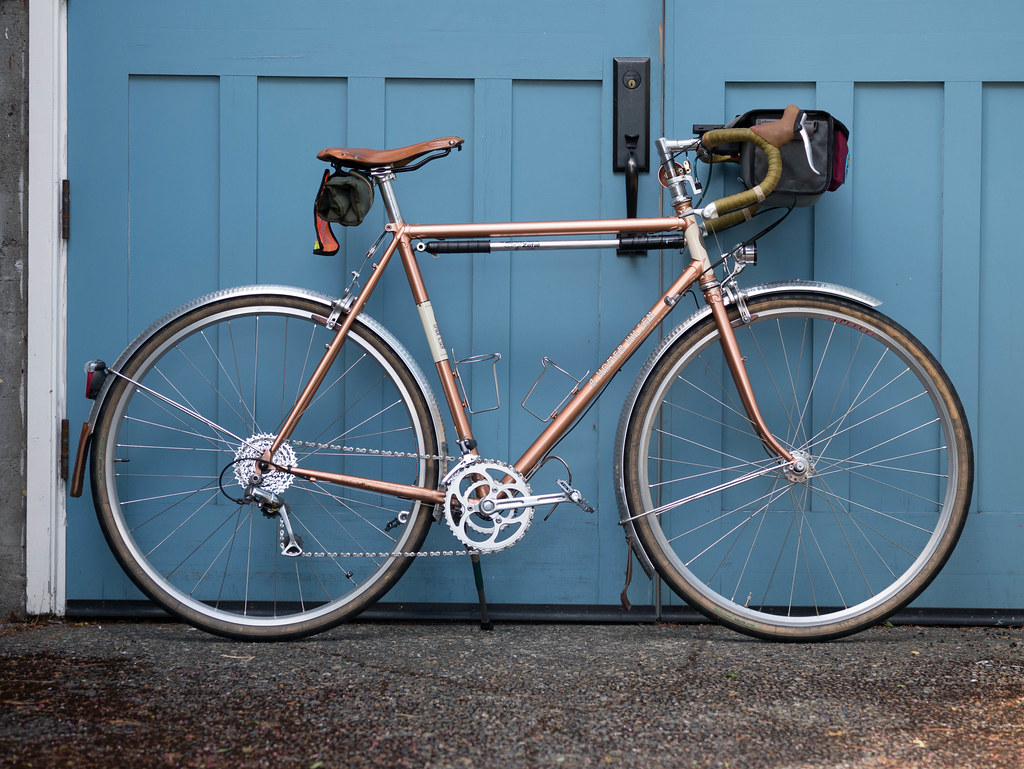
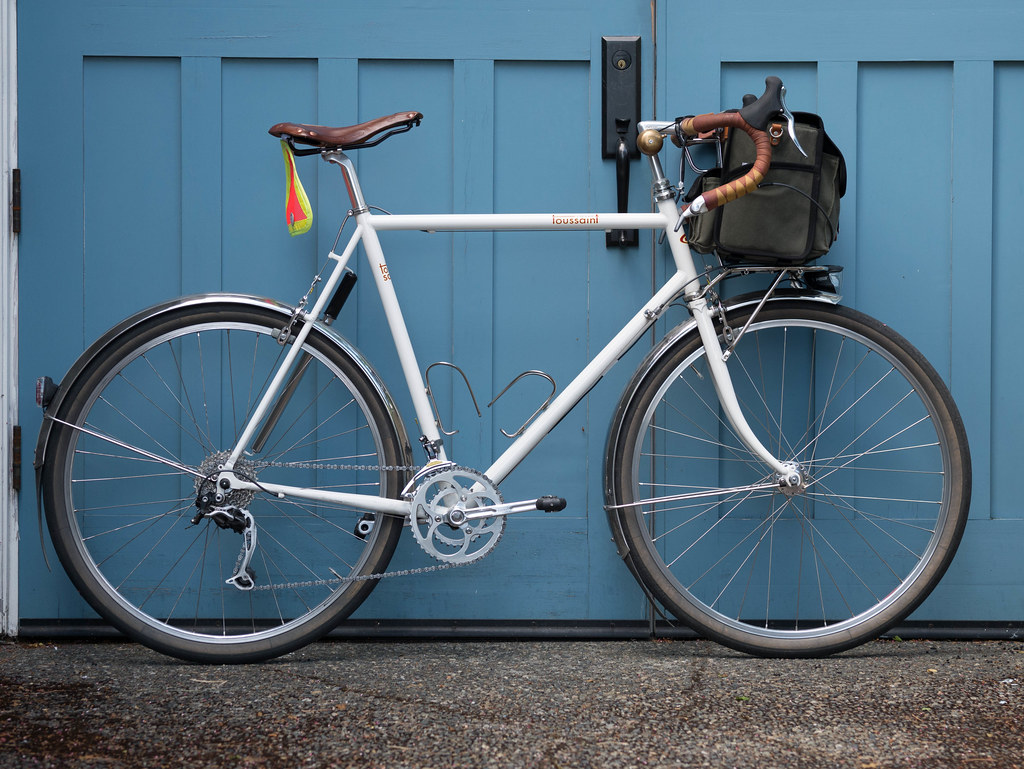
I want to go into a bit more detail on what I’ve found in experimenting with a more traditional low-trail bike like the Vélo Routier, and compare it to the mid trail Rivendell A. Homer Hilsen from my last post.  I have these bikes set up nearly the same.  Both use 42cm Noodles, Compass cranks, and VP pedals (not shown), and Selle Anatomica Titanico saddles.
BH-5.jpg BH-8.jpg

As the side view shows, the main difference is the fork rake and head tube and seat tube angles giving the bikes a slightly different geometry.  The Toussaint has slightly steeper angles, and more rake giving it trail around 30mm, whereas the Hilsen is more relaxed with trail around 55-60mm.  Yes, the Vélo is 650b and the Hilsen is 700c, but both bikes use light, supple Compass tires (tubeless even).  The tire volume has a definite impact on the ride, but it doesn’t really relate to how the trail aspect affects the feel of the bike, at least not in the detail I’ll get into here.

Steering Curves

You can definitely tell the difference in the feel that the geometry creates when doing tight turns on the bike.

I’ll start with a spot in my commute that “pushes” technique a bit. There is a railroad crossing on my daily ride where I perform a fairly tight “S” turn that has fences on either side to keep me honest.  The Hilsen requires more thought and body lean.  The Vélo Routier requires less body, and steers the curves easier.  This is the case no matter the load on the bikes for the most part.

On the other hand, when I put the Hilsen into a curve, it tracks it.  When I put the Vélo Routier in, it will still respond to inputs.  This can be good or bad.  I would say that on the Routier, I have to stay on top of steering all the time, whereas on the Hilsen, I have to be a little more planned up front, but when committed, it requires less concentration from me.

Front Weighted Loads

The Routier is much less concerned if there is weight in the front.  The bike doesn’t wag from side to side (wheel flop) when there is significant load, and when I park it with the front bag, it doesn’t sway over to the side.  The times I’ve actually found this to be nice is when I’m parking the bike, and when I’m carrying a 10+ pound load (which is actually very rare for me).

My typical rando load is probably at most 5 pounds in my front bag with a layer, extra gloves, and food. This is easily handled with little problem on the Hilsen when similarly front bag equipped.

Tracking

The Hilsen always wants to go straight at speed – there is more gyro stabilization effect with this geometry.  This helps when you want to be minimal in steering input.  Examples: curves, laziness, riding no-handed.  The Routier goes where your hands move it to.  This isn’t great if you are tired or distracted.  I’ve had a few more close calls on the Routier nearly going on a temporary off-road excursion.  This has been at normal riding pace: 12-17 mph.  I really noticed this “ultra responsive” steering at the end of a 300k when I was tired, and couldn’t seem to keep the bike going in a straight line without undue effort.  I remember thinking to myself that the low trail was supposed to be “easier”, but in this case, under fatigue, it was actually the opposite.  This is also a complaint generally fielded against higher trail bikes – that they tend to wander when climbing at slow speeds.

I’ve heard that wind gusts can really upset a higher trail bike, but I haven’t experienced that yet.  Gusts tend to bother me on either bike, but not uncontrollably so.

UPDATE: a comment left by a reader asked about high speed descent handling between the bikes.  I have noticed very little differences here – when moving at speeds over 20mph, both bikes feel stable.
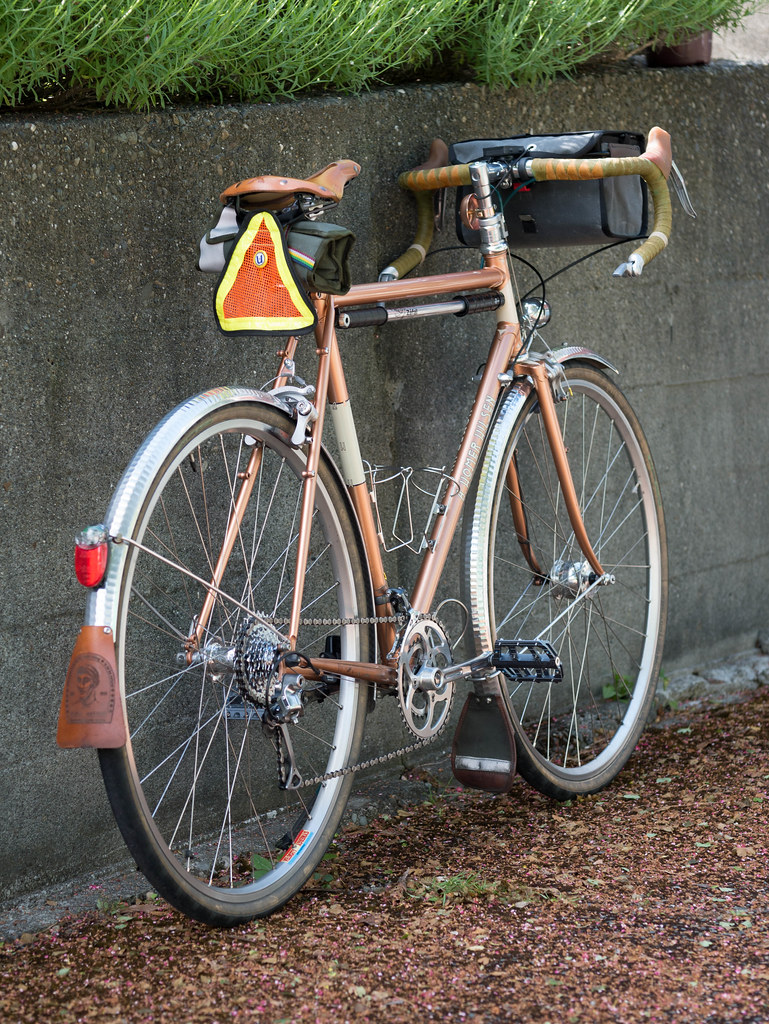
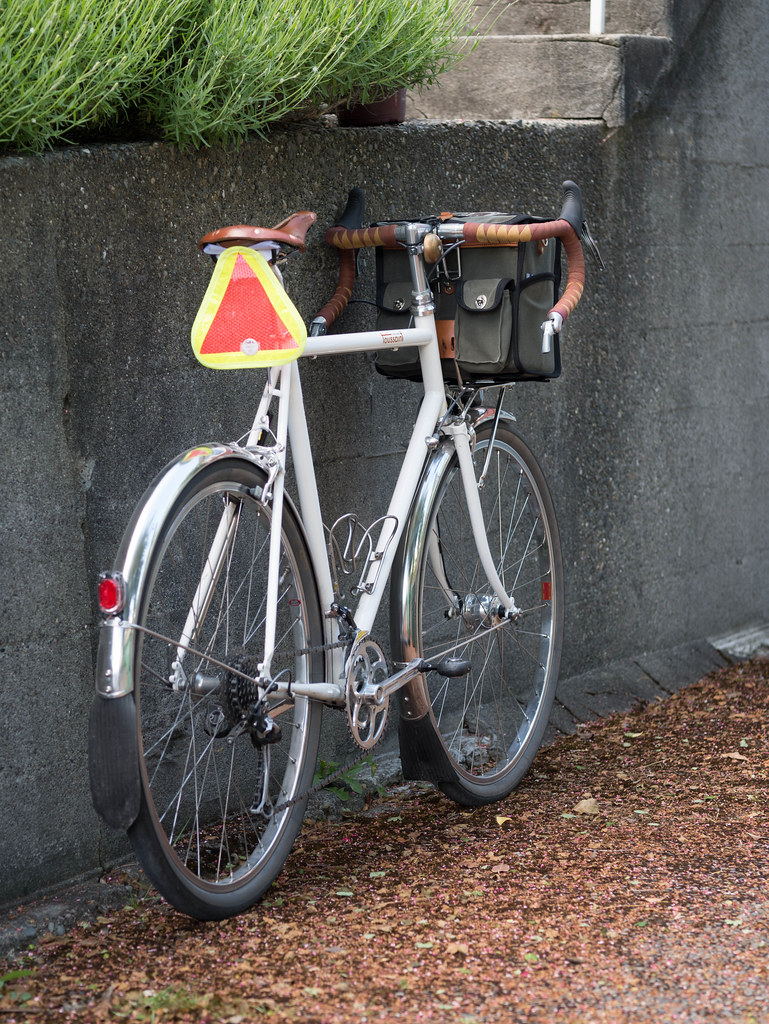
BH-2.jpg BH-7.jpg

Commuting

I find no real difference other than the amount of weight you want to carry. And, this only matters if you really want to carry a lot of weight in the front.  I tend to hate on rear rack and pannier combos as I don’t like the tail wagging the bike feel, and the dirt on the panniers from road spray. Front bags are awesome for keeping your stuff accessible and clean.  I don’t typically carry a lot of weight on my commute.  I keep heavy clothes in the office, and only occasionally bring an iPad or MacBook on the commute.  I will sometimes pick up beer, or other heavy items on the ride home, however, but either bike manages this for a few miles with no real problems.

Balance/CoG

Now here is something I’ve noticed more as I ride the Toussaint, and this is more obvious when I try to ride no-handed.  I feel like my center of gravity is higher on the low-trail bike.  It sort of feels like I’m sitting up higher and closer to the bars – more of an “on top” feeling rather than an “in the bike” feeling.  I would just attribute this to the sharper seat tube angle – not even something that necessarily contributes to the trail number, but is part of the geometry difference.

Summary

Different trails for different folks with different needs.  If you are a long-distance or endurance rider who carries a good load, is alert even after hours in the saddle (think 12+ hours), and you like to have a very precise feel for control on steering movements – go with a low trail ride.  If you are regularly carrying large loads, and want them to stay clean and dry, go low trail.  If you don’t mind carrying load in the back – it doesn’t really matter then.

If you like to ride long distances but want to be able to do lots of restful no-handed riding, and you like to zone out a bit more – go with a mid-trail bike.  If you are a commuter and want a bike that doesn’t flop over and pull the bike down when you have stuff in the front basket/bag, get a low trail bike.

If you like to ride big tires with fenders, or have bigger feet, and hate toe-overlap, you may find you will have less on a low-trail bike as the fork is raked out more.  Another consideration.

I find both of these bikes to be great brevet bikes.  They are also great commuters.  I would give the nod slightly to my Hilsen based on my riding style, preferences, and loaded weight characteristics.  Someday, I’ll have to “pull a Chen” and “get another Hilsen” that is modified to low trail and then do a test, but that sounds like a lot of work.  I’m moving out of my tweaking phase.  My real recommendation is to get two bikes, one low and one mid/high, and find out what you prefer.  Nobody can really just tell you – it helps to experience it yourself.
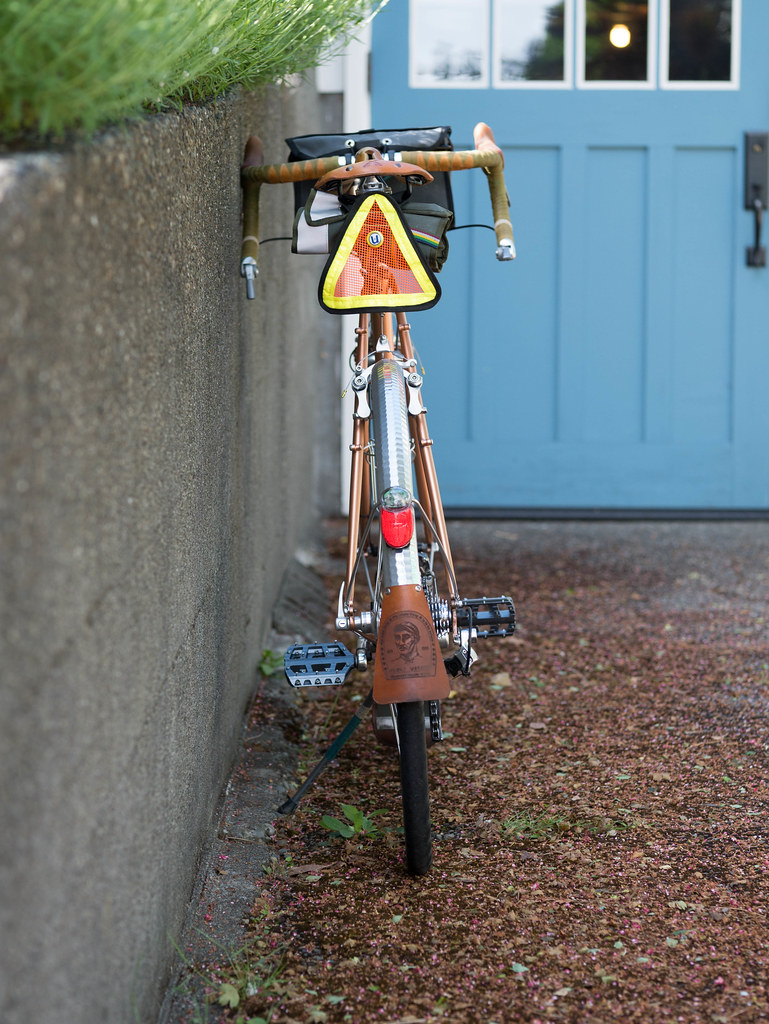
BH-4.jpg

Posted by Brian Hanson | Filed under Cycling, Randonneuring
≈ 10 Comments

Image

New Toussaints

23 Wednesday Dec 2015

Tags

bicycle, commute, cross, Cycles Toussaint, gravel, pavé, randoneurring, Velo Routier


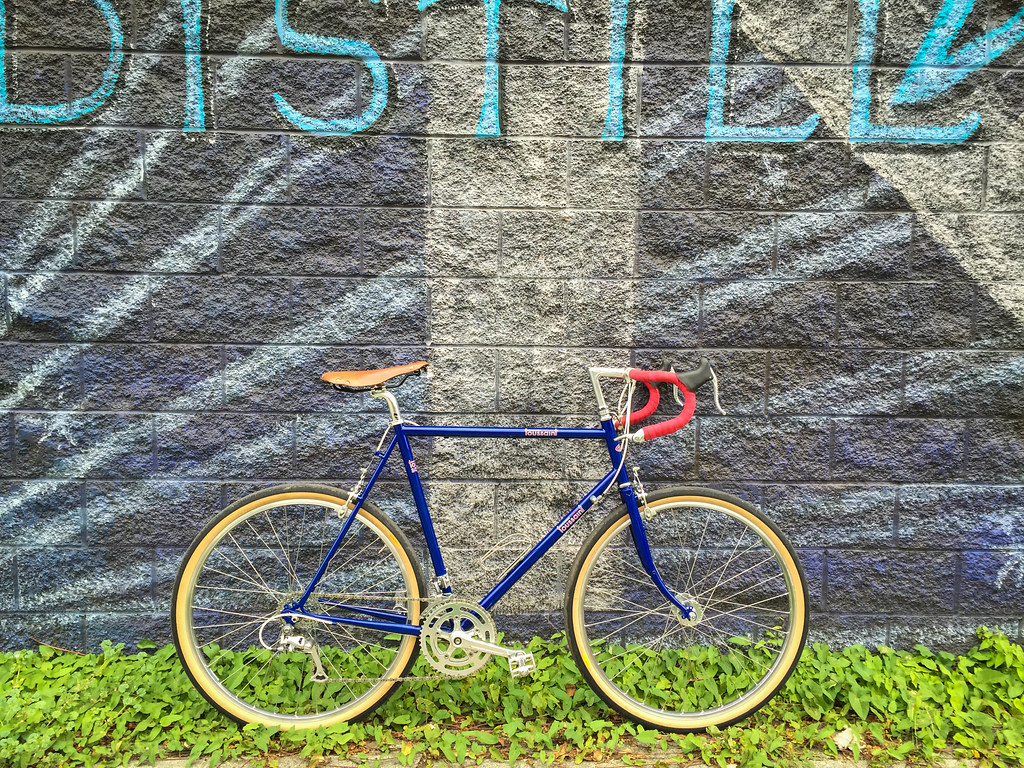
Our northern buddies at Cycles Toussaint in Calgary have introduced a new Vélo Routier.  I took one out for a spin to see how it compared to my v1 bike.

BH-2.jpg

V2 Vélo Routier

My first impression was that it felt just like my Vélo Routier. I’m not sure that I would be able to tell the difference in a blind test. It felt planted and quick steering.  Comfortable, not quirky.  This was set up similar to my own bike, with a Selle Anatomica, Noodles, bar-end shifting, and Compass tires.  This geometry just works for me.  Nice bike, great brakes.  They offer the v2 in 2 versions – one with braze-ons, and one without.  I really like the braze-on centerpulls and the quirky seat-stay pump mount, so that would be my choice.  The blue color is a nice change, too.  One new quirk – there is a slotted rear axle mount now, to better accommodate IGH or fixed/single gear hubs.  While this opens up the bike to more options, it may make bikes with fenders tougher to change out a flat on, but there are ways around the problem.

BH-4.jpg

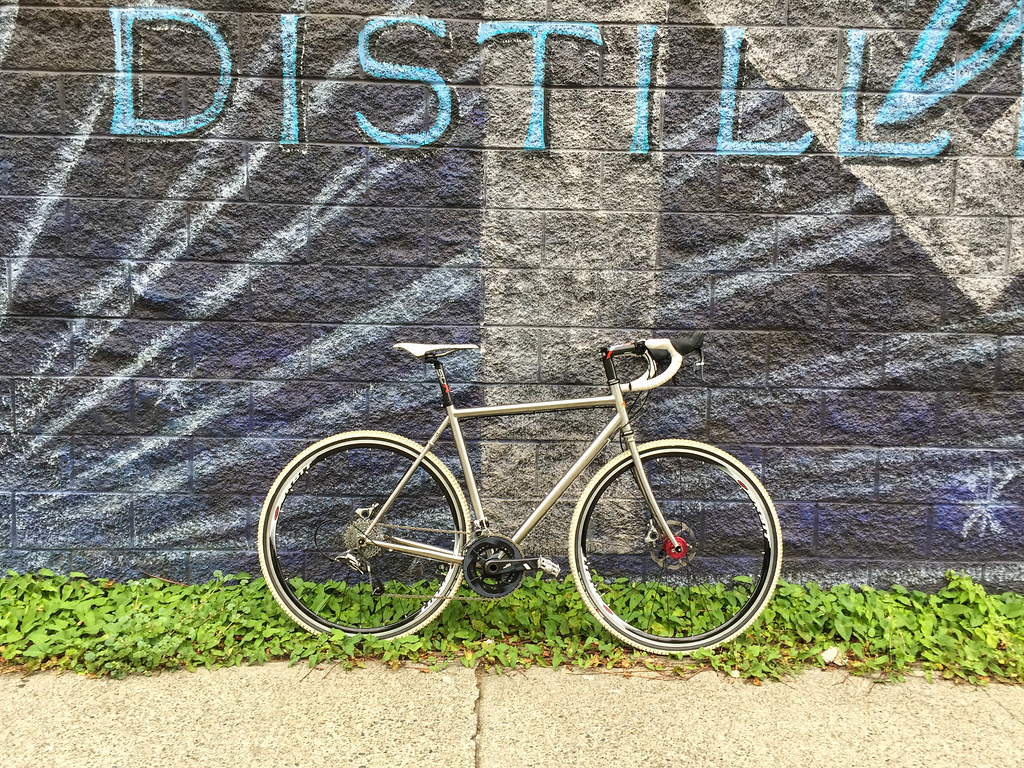
Toussaint Pavé

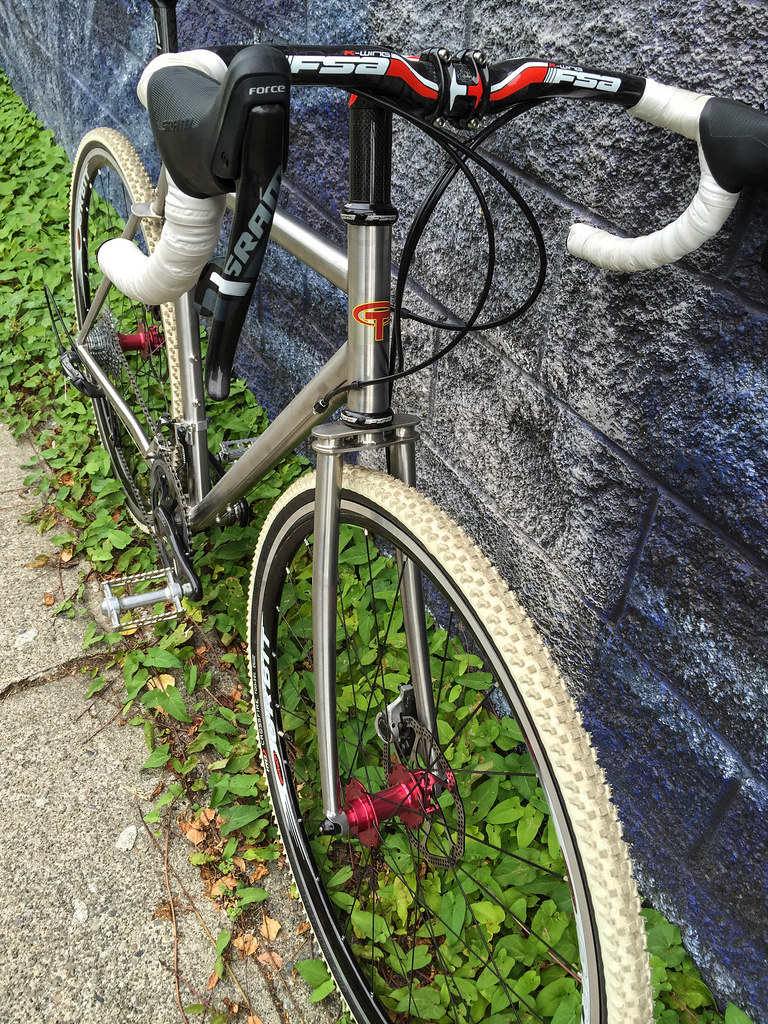
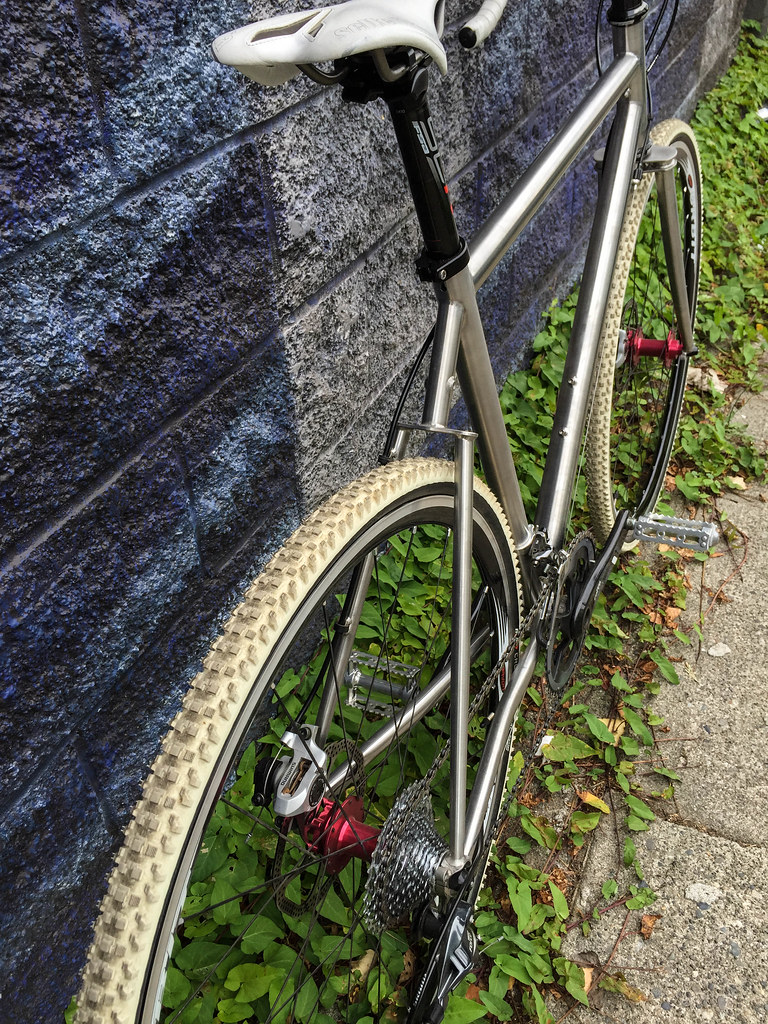
The next bike is a demo that is a new direction for Toussaint.  I believe this is an all-round road/gravel, maybe even cross bike.  It was set up racier than I would typically ride, but it was surprising in a number of ways.  The tubing is all stainless steel, which gives it a fairly “ti” look.  The downtube is quite oversized, as well, at 38.1mm. This seems overly stiff for my weight range, but can be offset with cushy tires. It is spec’d to take a 45mm fender, so I would assume you could put the Compass Barlow Pass tires on with no problems. It looks like a Clement MSO would fit fine for a bit more bite.

Toussaint used interesting plated fork and seat stay crowns. I like the classic low fork bend of the Routier more. To my eyes, it would be a great match for the double plate crown on this bike. The “banana” bend just looks odd to me.  I assume it makes the disc attachment easier/stiffer, but if the bike could use a more classic bend here, it would be prettier.


BH-5.jpg

Double Plate Crown

Disks make it a great utility rain bike.  I found the bike to be quite like the Vélo Routier in feel – even with a bit more trail on the Pavé (45mm).  It still felt quick steering, and was light and fun to ride. I was wondering how it would be with some front or rear load. I may see if I can get an extended trial to find out.

BH-6.jpg

Seat Stays

After the ride, I am hopeful this bike would fall into a similar price range as the Vélo Routier – if you could get a bike built for the rainy NW commute, not have to worry about rust or wet brakes, and still maintain great geometry that would handle randonneuring or lightly loaded gravel adventure rides – nirvana, right there!

The Toussaint blog (with lots of good info on the tubing, geometry, etc…) is saying they hope to sell these for around $2000, so I guess the tubing makes a big difference, but we’ll see what happens if they do a production run. This is a cool, practical bike!

Posted by Brian Hanson | Filed under Cycling, Northwest

≈ Leave a comment

Tubeless vs. Staple

25 Sunday Jan 2015

Posted by Brian Hanson in Cycling

≈ 1 Comment

Tags

flat tire, Hetre, hetre EL, Stan's, Toussaint, tubeless, Velo Routier


BH-1.jpg

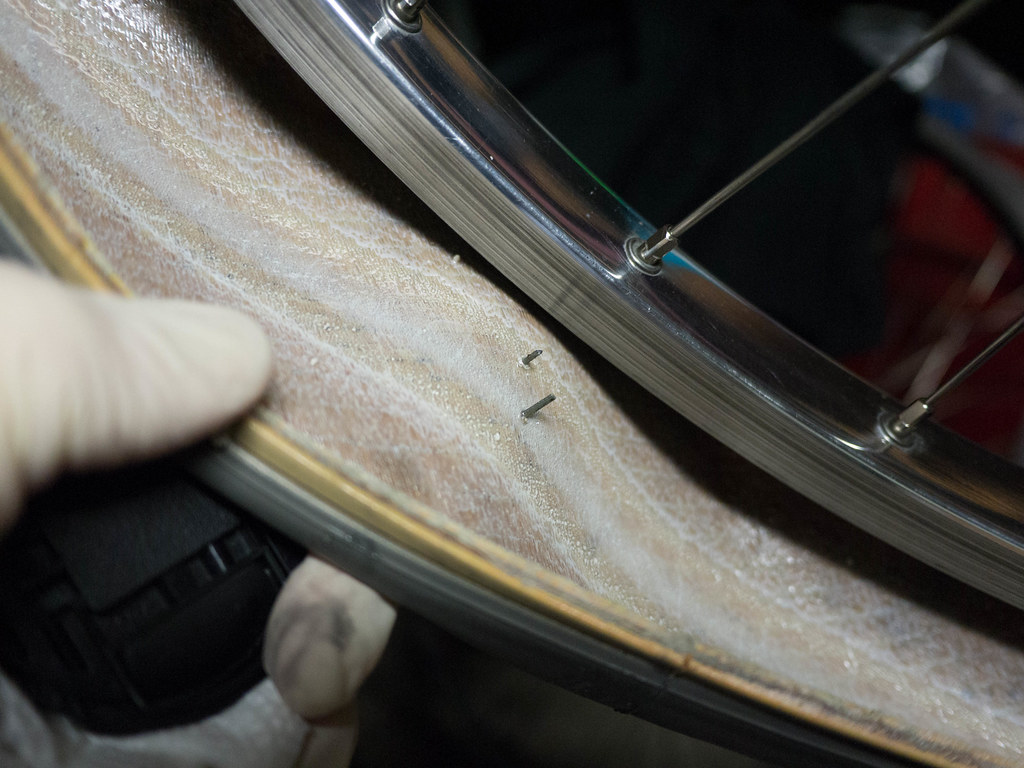
After about 6 months of riding my Velo Routier on tubeless Hetre ELs, it was time to “change the fluid”. I wasn’t sure how long before the first batch would be dried up and gone. After riding to the beach and back, I noticed a slow leak in the front tire. I brought it back home, got out the Stan’s, and gave it a refill without having to remove the whole tire. I noticed that there was a uniform white residue along the inside of the tire including the sidewalls. There were a few chunks of latex that pooled up around what I took for small holes, and I wiped out the inside of the tire before putting in a fresh couple ounces and refilling the tire. I was able to remount the tire and use my floor pump to pop the bead back into place with little effort.

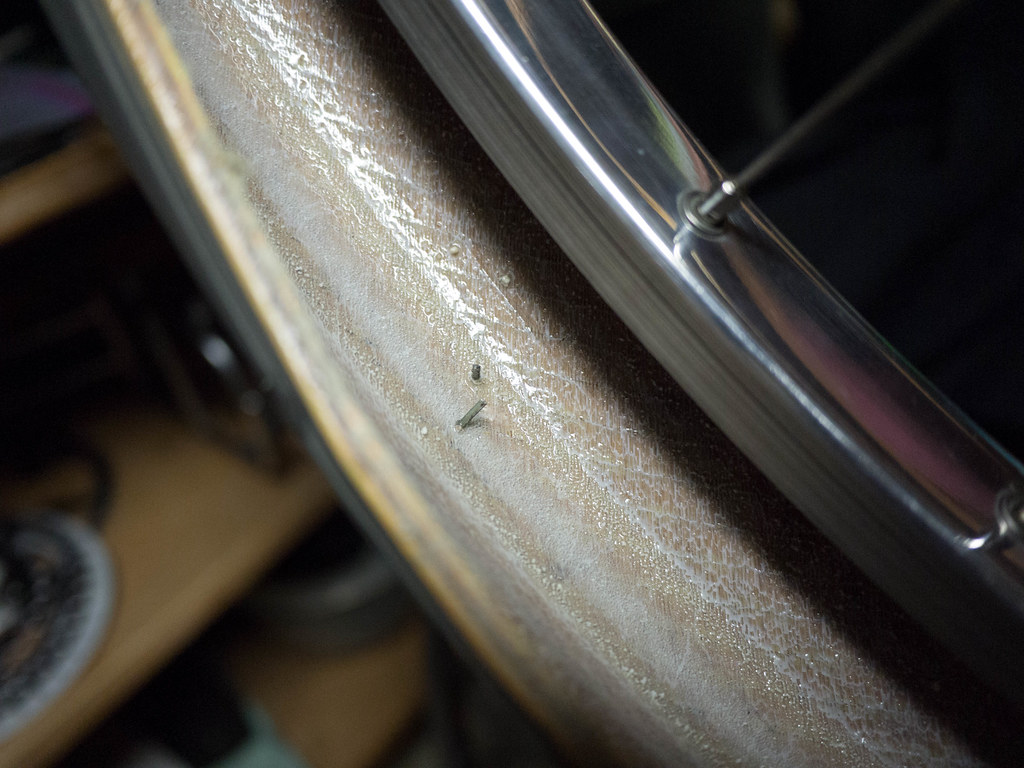
After a few rides, I started to wonder if I was running on borrowed time with the rear – since that is always the tire that goes flat for me. There had been no noticeable puddle of Stan’s in the front tire when I popped it open. To put my mind at ease, tonight I put the bike up in the stand and popped one side off the rim of the rear wheel. While wiping out the remaining Stan’s (about a teaspoon left – mostly viscous yellow – no sign of the white latex still in the suspension), I noticed the twin prongs of a perfect staple that had pierced the tire mid-tread.

BH-2.jpg

I tried to find it on the outside of the tire to remove it the way it had gone in, but the connecting bar had broken off the tines. I removed them from the inside. I have no idea how long that staple was in there. It could have happened shortly after I started riding these tires tubeless, or it could have happened last week. One thing is certain – I would have had a flat had I been using tubes. As it stands, I didn’t notice the puncture until I went to perform maintenance on the tire.

Pretty cool! I think a few more of my tires will be losing their tubes in the future.

Weights

16 Saturday Aug 2014

Posted by Brian Hanson in Cycling

≈ 6 Comments

Tags

a. homer hilsen, acorn bags, ahh, B17, bike weight, brooks, Cycles Toussaint, cycling, dynamo lighting, hilsen, Hunqapillar, nitto, rivendell, sackville, Selle Anatomica, Velo Routier


I recently weighed my bicycles to respond to a thread on the RBW list.  Folks were posting their Rivendell bike weight for some reason, even though everyone knows if you own a Riv, you don’t obsess over gram counting.  I had weighed my A. Homer Hilsen when I originally built it up, but before any fenders, racks, or bags were added.  It came out around 25 lbs, so I was interested in how much it weighed after accumulating various accessories over the past 5 years.

Original 25-pounder

The latest version of the bike is coming in about 4 pounds heavier.  Even with a lighter double crankset and bars, but fenders, bags, and dynamo lights/hub add up!  I think the bike is much more useful at 29 pounds, and it still feels pretty light to me.  Not feathery like a Ti or carbon bike, but plenty sprintable for my purposes.  It’s nice to have lights, toolkit, water spray protection, and carrying capacity when you need it, too.

BH-5.jpg

I knew the Hunqapillar was going to be a beast based on the thicker gauge tubeset, and all the extra rack and bag weight on this bike.  It is a touring/camping bike, so it’s nice to have the stability when I’m carrying camp gear.  All this adds up to another 10 pounds over the Hilsen.  It weighed in at 39 pounds in camp-ready mode with bag, basket, and tools loaded for bear.

BH-9.jpg

Ironically, this is not too far off a modern dual-suspension mountain bike.

BH-6.jpg

The Toussaint had to be weighed since the Rivendells were on the scale (a Nintendo Wii with Fit, BTW – I don’t own a scale).  This bike has a slightly heavier bag than the Hilsen, and 650B wheels, but otherwise it is set up with identical cockpit, hub, and crank configurations.  All in with tools, it came out 1 lb heavier at 30 pounds.

BH-8.jpg

OK – now back to not caring about weight, and just riding my bikes.  Having a great time, BTW…

Tale of two rando bikes

28 Wednesday May 2014

Posted by Brian Hanson in Cycling

≈ 3 Comments

Tags

a. homer hilsen, Barlow Pass, brevet, Cycles Toussaint, jack brown, light bike tires, randonneur, rivendell, tires, Velo Routier


After my brief flirtation with a bigger tire on my Hilsen, I’m back to the real original version.  Jack Brown 33.3s.  They actually measure just under 34mm, so only 3 or 4 mm smaller than the Barlows.  Who knew!  They feel great, and I don’t have as much toe overlap with this setup.

BH-1.jpg

I noticed how much this bike is like the “new” rando I’ve been taking on the longer rides this year.  Slightly different geometry on the frames, different tire size, but really close to the same measurements at the body contact points.  Here are two side by sides:

A. Homer Hilsen

BH-5.jpg

Velo Routier

BH-8.jpg

I’m using the same seat, bars, and cranks.  Pedals will soon be the same if I can make up my mind on the clipless of choice.  There is one main difference I could feel today on my ride home.  The bars on the Hilsen are 2cm above seat height.  On the Routier, they are only  1cm above the seat.  This was changed as soon as i got home as I’ve been plenty comfortable on the Routier this season, and the Hilsen actually felt a bit odd – like I was riding a “comfort” setting.  It was not feeling quite the same in the power output.  With the bars dropped, and a test ride to confirm, I now have a spare rando bike (it was actually the original brevet bike and did just fine for the past two seasons).

BH-4.jpg

Now I just need to get the time to actually devote a day to a ride!


← Older posts

Flickr Photos

BH-68.jpgBH-67.jpgBH-66.jpgBH-65.jpgBH-64.jpgBH-63.jpgBH-62.jpgBH-61.jpgBH-60.jpgBH-59.jpg
More Photos

Archive

  • August 2020 (1)
  • March 2018 (1)
  • January 2018 (1)
  • July 2017 (1)
  • June 2017 (1)
  • May 2017 (1)
  • February 2017 (1)
  • December 2016 (1)
  • November 2016 (1)
  • August 2016 (2)
  • March 2016 (1)
  • January 2016 (6)
  • December 2015 (2)
  • November 2015 (1)
  • June 2015 (5)
  • May 2015 (1)
  • April 2015 (1)
  • March 2015 (2)
  • January 2015 (2)
  • December 2014 (2)
  • November 2014 (2)
  • October 2014 (2)
  • September 2014 (2)
  • August 2014 (1)
  • July 2014 (1)
  • June 2014 (1)
  • May 2014 (2)
  • April 2014 (5)
  • March 2014 (4)
  • February 2014 (4)
  • January 2014 (6)
  • December 2013 (1)
  • November 2013 (2)
  • October 2013 (2)
  • September 2013 (1)
  • August 2013 (1)
  • July 2013 (2)
  • May 2013 (6)
  • April 2013 (1)
  • March 2013 (6)
  • February 2013 (2)
  • January 2013 (7)
  • December 2012 (5)
  • November 2012 (2)
  • October 2012 (2)
  • September 2012 (3)
  • August 2012 (3)
  • July 2012 (1)
  • June 2012 (4)
  • May 2012 (7)
  • April 2012 (1)
  • March 2012 (1)
  • February 2012 (4)
  • January 2012 (5)
  • December 2011 (6)
  • November 2011 (4)
  • June 2011 (2)
  • May 2011 (4)
  • March 2011 (2)
  • February 2011 (4)

Enter your email address to follow this blog and receive notifications of new posts by email.

Join 96 other subscribers

Blog at WordPress.com.

  • Subscribe Subscribed
    • Cycle Seattle
    • Join 96 other subscribers
    • Already have a WordPress.com account? Log in now.
    • Cycle Seattle
    • Subscribe Subscribed
    • Sign up
    • Log in
    • Report this content
    • View site in Reader
    • Manage subscriptions
    • Collapse this bar