• About Me

Cycle Seattle

~ Posts on bikes

Cycle Seattle

Category Archives: Cycling

Shoes for Cycles

08 Wednesday Jan 2014

Posted by Brian Hanson in Cycling

≈ 6 Comments

Tags

approach shoes, bike fit, clipless shoes, cruzer, cycling shoes, evolv, five ten, just ride, shoes, skate shoes, sneaker pedals, spitfire


Sneakers

Sneakers

Shoes.  I’m one of those folks that have a bunch of these things – I’ve been a bit obsessed about them at times.  I have 3 pairs of clipless shoes, and at this point 5 pairs of sneakers that qualify as bike-first, walking shoes.  I’ve had a professional bike fit for my road bike with my SPD pedals.  There are some that say clipless is pointless for all but the most dedicated racers, but I think that there is a time and place for many different shoes on bikes.  One of my favorite pedals has been the Shimano A530.  This pedal has SPD on one side, and flats on the other.  I’ve done 300k on these pedals, and have commuted for several years in both SPD and flat shoes.
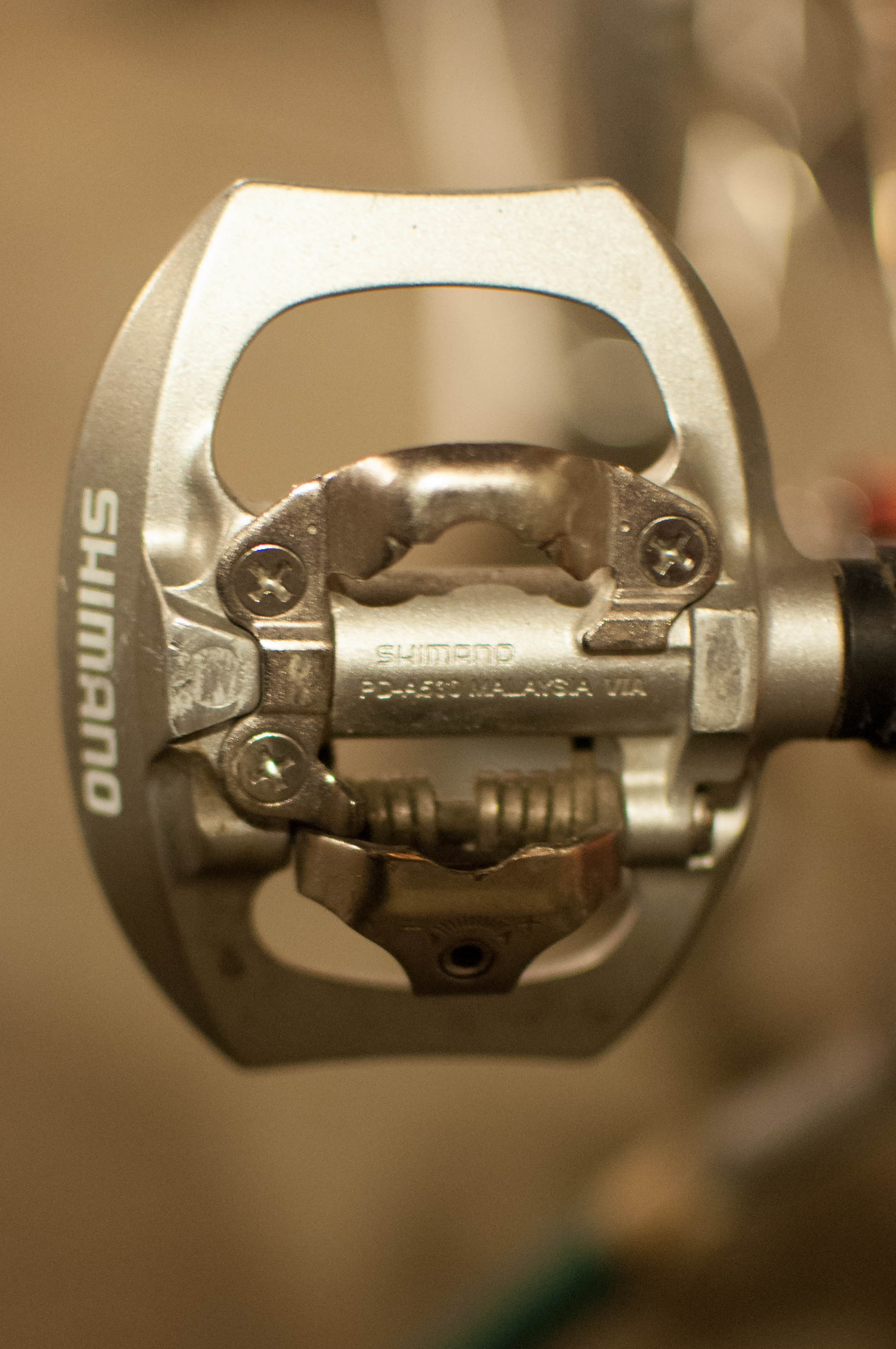
PD-A530 Pedal

PD-A530 Pedal

I’m starting to form some opinions on what shoe, what situation at this point, however, this year I’d like to do at least one ride of 200k plus in sneakers.   I was told by my fitter that it’s easier on the legs and knees to be clipped in.  The reasoning was explained to me as it makes less work for you as your feet won’t be moving around on the pedal and getting mis-aligned.  This seems counter-intuitive to me.  I feel like there has to be some give during the pedal rotation in the “play” of your shoe or your knee tendons will be slightly stretched.  I think this manifested last year on my longest ride when my right knee went out with 50 miles to go.  I don’t know how many folks have knees that are aligned in perfect planes to the pedal rotation – mine definitely aren’t.

Since I’ve been clipping in and out of pedals for 20 years now, I’m pretty comfortable with the technical points.  When you start going clipless, do it in the dirt on the hills.  It’s like learning to drive a manual transmission first.  You get the hardest part out of the way, and master it early.  You often have to get clipped in when you’re going up a 20% grade in dirt or mud with rocks and roots in the way, and you quickly learn the key ways to start pedaling and transfer your weight quickly so you can get that second pedal going before you stall.  You also learn how to anticipate and unclip (or panic unclip) when you come to a sudden unintentional stop on that rock/root in the trail.  If you don’t, it’s a softer landing in the dirt (usually).
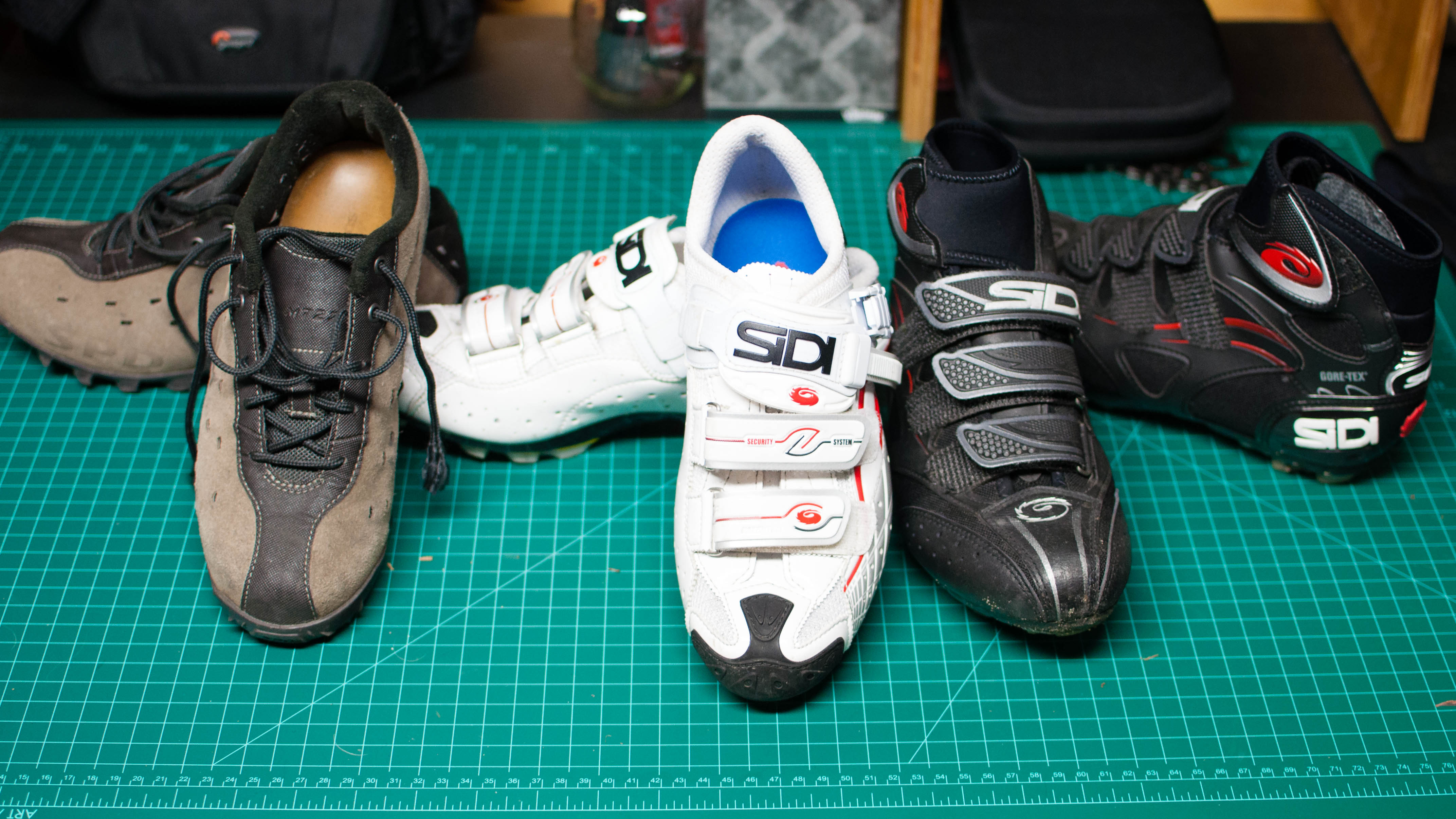
jbt-2014-01-08-4

Clipless for all seasons

Clipping in and out isn’t a problem.  It’s really just the longer rides and the stresses it introduces that make me wonder if it’s not a great idea.  I also don’t find myself using the real benefits of clipless (picking up the bike, or keeping your feet glued to the pedals when airborne) while I’m riding a road bike.  I admit it is nice sometimes when I have to make a quick curb hop, but that’s pretty rare…

VP Vice

VP Vice

VP 001 Pedal

VP 001 “Thin Gripster” Pedal

Using modern flat sneaker pedals like VP Components Vice or VP001 meant for BMX and freeride mountain biking, along with a sticky-soled shoe like a Five Ten Spitfire (current fave) or Evolv Cruzers has been really interesting to me.  It provides such a sticky grip, I find myself having to lift my foot to move it on the pedal.  This gives me nearly the feel of clipless, but at stops I don’t have to twist out or clip in, and I can walk around in normal sneakers.  This is really great for the following situations:

  1. Commuting – I have a lot of lights and stop signs on the way to work.  It’s nice to put both feet down…
  2. Errands/shopping – wearing cleats in restaurants and shopping sucks.
  3. Visiting friends/relatives – no need to clomp around  or take off the shoes.
  4. Just riding.  I don’t have to do the “uniform up” before the ride – I just jump on the bike and go.  Liberating!

There are still times I prefer clipless:

  1. Mountain biking – gotta get maximum lift to clear those bitchin’ logs – although I may just need to learn the trials tricks and pick the bike up with my arms and bounce.
  2. Long road rides – this is perhaps debatable, but it is good to have an ultra stiff shoe so the feet don’t get sore
  3. Racing?  I don’t do this, so YMMV.

On the long rides, I need to work out the trade off between foot pain and knee pain.  If I can get the balance just right on the knees, I may be able to keep going clipless, as the roads are generally smooth, and there are minimal stops and long distances involved.  We’ll see…

1/16/14 Update:  I angled the cleat on my Sidi Spyders to get my right foot out a few degrees.  This seems to have helped.  I didn’t get any knee soreness this week (yet).  I plan to start doing some longer 30+ milers going forward, so we shall see…

2013 Cycling

03 Friday Jan 2014

Posted by Brian Hanson in Cycling

≈ 4 Comments

Tags

2013, a. homer hilsen, Artist's Point, Babyshoe Pass, Hunqapillar, llandover woods, new years ride, randonneur, rivendell, Selle Anatomica, SIR


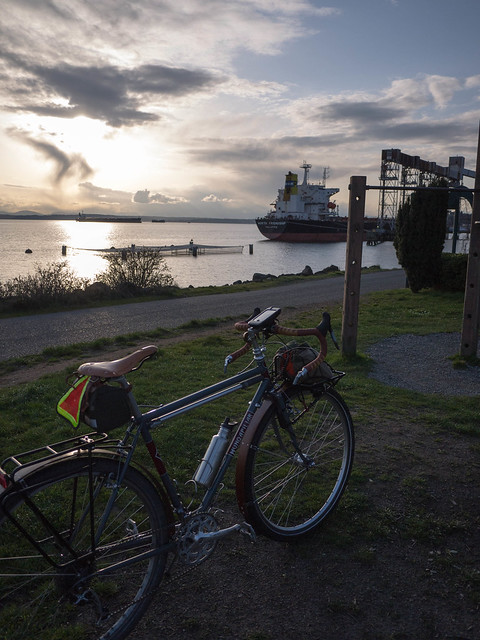
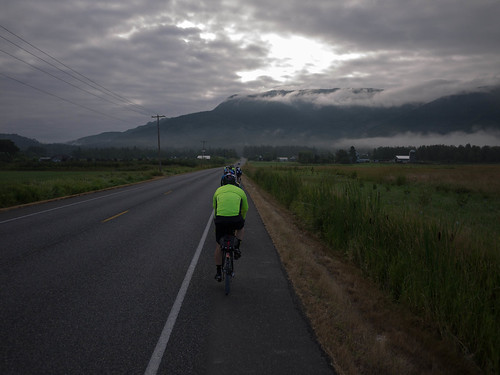
This was my best cycling year yet.  I rode over 3000 miles on my bikes in 2013, and a couple of the rides were really long.  Now, the vast majority of my miles are commuting, and I added to my commute mileage this year by taking a longer route home.  It is much more scenic, and it allows me to stay on lightly used trails for the majority of the way.  This makes my commute much less stressful, and adds a ton of scenic beauty.

Serene

HunQa-12.jpg

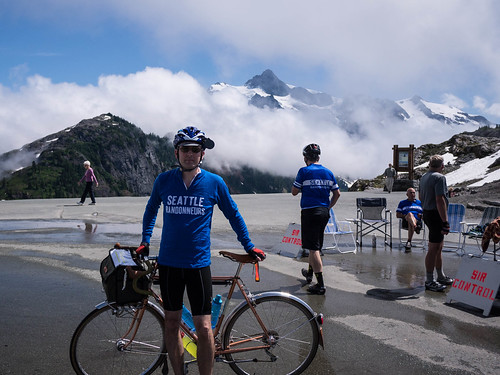
I rode a few events with the Seattle Int’l Randonneurs club this year.  It’s still tough to get out as much as I want – it takes a full-day commitment for most of the events, but I’m shooting for more in 2014.

Your's Truly

An early March 200k  was a good starter for me.  The ride went really well, and sold me on the Selle Anatomica Titanico X saddle.  I experienced no numbness or pain at the end of the ride.  I was also able to do this one right from home, so there was no drive to the start, or long ride home.  It helped me get the confidence I needed for August’s 300k.

Homer-85.jpg

Another highlight was a ride in early June where some new friends and I went in search of the famous Babyshoe Pass.  The folks I camped and rode with were an awesome, eclectic bunch from Portland, Seattle, and Enumclaw.

Homer-62.jpg

Homer-57.jpg

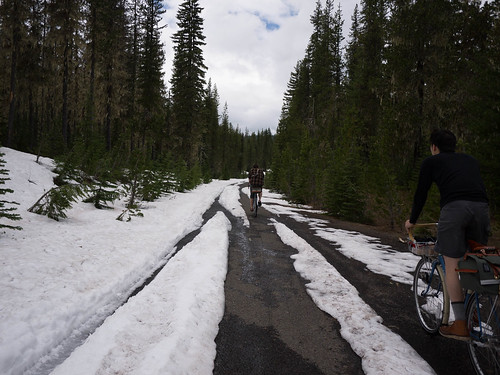
This was a ride that reminded me how much fun exploring mountain roads can be.  The 3-volcano area is one I’ll be back to explore.  I also got a taste of riding the A. Homer Hilsen set up in rando garb through a snowfield, and down a rocking mountain bike trail at speed.  Underbiking at its best.  Perhaps it would have been smarter to pick the Hunqa that day, but the AHH did just fine, even after a flat and an unplanned endo into the snow.

Homer-89.jpg

Alas, we were a few weeks early, and the snow had not melted up to the pass, so we migrated back before the summit, but the ride down was the best ride of the year, easily!

I was able to introduce a couple folks to commuting in 2013.  One of my neighbors wanted to start riding once a week.  He works near my office (downtown Seattle) so I showed him a few routes that I use regularly, and tried to give him enough advice to keep him safe.  Another friend bought a new bike for the first time in years, and we rode home off and on for a few months.  We also did a nice ride around North Seattle and found a good trail in Llandover Woods. Unfortunately, we found that the trail was closed to bikes (after we traversed it…)

TroyD

The apex of the riding year was my first 300k in August.  This was both awesome (Artists Point) and brutal (needed lots of advil to get home).  My knee gave out just past the 200k mark while I was riding with a fast group.  I dropped off the back when I started to feel like I couldn’t push down on the pedal with my right leg.  I stopped and stretched in a field by the side of the road for a bit, and limped along for another 50k before I found a gas station where I could buy ibuprofen.  This helped ease the pain so I could continue riding, but I was basically using my left leg and only lifting with my right.  That ride was tough and took all my willpower to get through.  I felt elated at the end, however.  It was amazing to go so far in one day.

300k-8.jpg

300k-5.jpg

300k-17.jpg

Happy New Year!  I hope you all get out and ride more this year!

Locks and Gardens

02 Thursday Jan 2014

Posted by Brian Hanson in Cycling

≈ Leave a comment

Tags

ballard locks, fishermans wharf, Fremont, golden gardens, Hunqapillar, magnolia, Maple Leaf, new years ride, rivendell


I took the Hunqapillar out on a 19-miler today to get some biking in the New Year. It was a beautiful, warmish day with nice light. The route I’m starting to make into a training ride takes me on a loop through some of the more scenic parts of north Seattle.

BH-1.jpgBH-2.jpgBH-3.jpgBH-4.jpgBH-5.jpgBH-6.jpg
BH-7.jpgBH-8.jpgBH-9.jpgBH-10.jpgBH-11.jpgBH-12.jpg
BH-13.jpgBH-14.jpgBH-15.jpgBH-16.jpgBH-17.jpgBH-18.jpg
BH-19.jpgBH-20.jpgBH-21.jpgBH-22.jpgBH-23.jpgBH-24.jpg

Locks and Gardens, a set on Flickr.

I start the ride from Maple Leaf and make my way through the U of W campus. I use trails through Fremont and lower Magnolia to the Ballard Locks. There was little activity there, so it was a breeze to cross over to the north side of the canal.
I picked up the trail to Golden Gardens. At that point the climbing starts with a nice quick rise to Crown Hill. Several ridges take be back through Greenwood to Maple Leaf.

Cycling Stats

27 Friday Dec 2013

Posted by Brian Hanson in Cycling

≈ Leave a comment

Tags

bike computer, cyclemeter, dailymile, excel, garmin, google glass, iCloud, iphone, randonneur, RAV power, rflkt, runkeeper, Seattle Randonneurs, SIR, stats, wahoo fitness


Being a geek, I have been collecting data on my rides for the past 5 years.  I’ve gone through several approaches, and certainly don’t have a vast knowledge of all that’s out there, but I’ll tell you what works for me these days.

When I moved back to Seattle and started bike commuting again I discovered I could use my new phone (iPhone 3gs) with an app called Trail Guru written by Tim Park.  It quickly became my favorite app, although I tried quite a few.  Having a GPS built into the phone was one of the “killer apps” for the burgeoning smart phone market, and this was something I used twice daily.  Lo and behold, sometime in 2011, Trail Guru stopped working, and there was no word from Tim.  Eventually, the app fell out of the App Store, and I had to move on.  Unfortunately, the web site went offline and so did my data.

This soured me on the smartphone idea for a while.  I picked up a Garmin eTrex 20 for an upcoming brevet.  This would solve another problem with the smartphones – my iPhone was good for a max recorded time of  about 4 hours when the GPS app was active, even with the display turned off.  The Garmin should last 20+ hours, and used AA batteries that I could bring along for spares.  Unfortunately, things didn’t work out too well – I did the ride, but on a commute home a week later, the unit popped off the mount on my handlebars and was gone forever.  After this short-lived experiment, I went back to the phone again.  Besides the mount problem, the Garmin software was prehistoric.  It was clunky, confusing, and getting the data on the computer was much harder than it should be.  OK – I expect wireless in everything these days, people!!

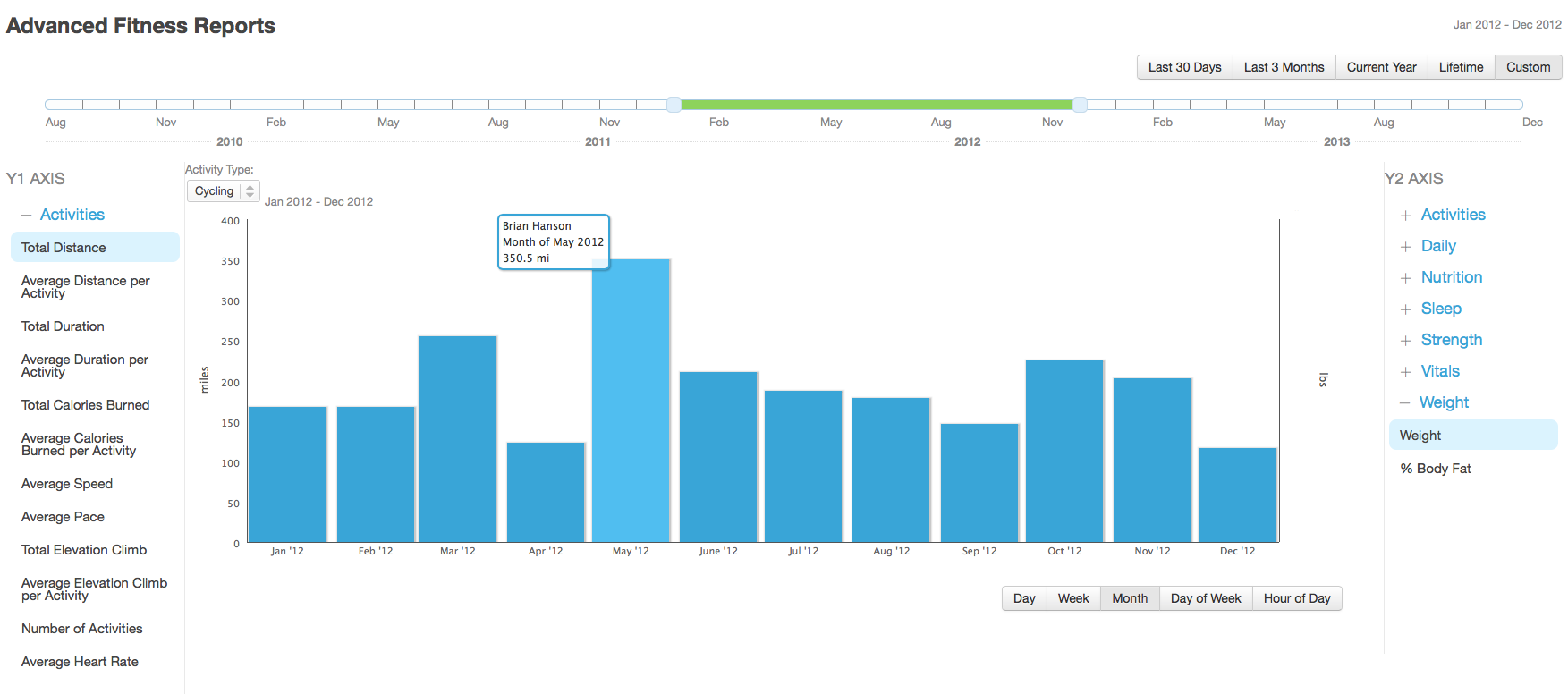
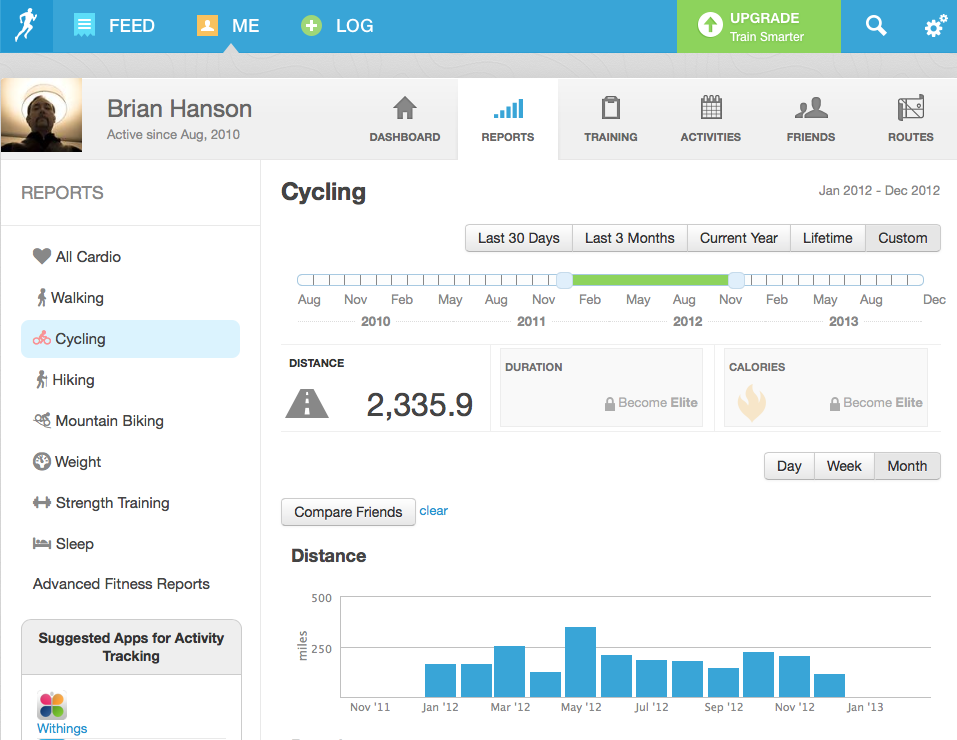
I started using RunKeeper (iOS app) and, although it wasn’t specifically made for a cyclist, I really like the reporting available.  It does a great job of letting you see your data and jumbling it around however you like.  Here’s an example of the “advanced fitness reports” page from their site:

RunKeeper

One of the downsides, however, was the subscription based “elite” membership you need to see a lot of the reports.  The other thing I didn’t like about it was the simple cycling screen that wasn’t adjustable.  It only showed a select group of data points, and this was not negotiable.  That said, I used it for all of 2012, and it was rock solid reliable, and simple to use.  

RunKeeper Total 2012

I was lured away by a post in one of the cycling groups I follow that mentioned Cyclemeter.  This app was a phone-only application, but it tied into various websites for data display on a computer.  That said, most of the data is displayed very well on the iPhone itself.  You can export it via .csv as well, so it’s simple to save the data and work on it in Excel or whatever you like.  (at this point, Cyclemeter allows saving its database to iCloud)

Cyclemeter3                 Cyclemeter2                 Cyclemeter1

I liked the display versatility better than RunKeeper, and tied it into dailymile.com for viewing on the web.  This site is a social media site that focuses mainly on the community aspect of workouts, so it doesn’t do a lot of advanced analytics, but if you just want a place to log your mileage, it works.

Daily Mile 2013

This is a view I built in Excel from a data dump directly from Cyclemeter.  Much more versatile, but a bit more work.

2013 Cycling Stats

This leads me to the problem of having a speedometer on the bike.  I tried a handlebar mounted iPhone case for a while, but found it a bit too bulky and over the top.  I never lost it, or got it wet, but it wasn’t exactly svelte.  The other problem was battery.  I couldn’t really use it as a display for anything longer than an hour or two without draining the battery.  The combination of LCD and GPS puts too much hurt on battery life.  I wanted to do longer rides with the Seattle Randonneurs, and a 200k takes me about 9-10 hrs.  I could get by barely by using my dyno hub to charge the phone during the day, but for any ride that goes into the night, I would lose that capability.  All the power coming from the dyno would need to be used for my front and rear lighting.

I became convinced that the newer Garmin Edge GPS units for cycling would be better.  I picked up an Edge 810 and within a month brought it back to REI.  Garmin still hadn’t fixed the confusing software, and to top it off, the hardware routinely shut off in the middle of a ride.  The whole point of this device is to be on and track a ride from start to finish.  I tried a few firmware updates, but it never worked the way I wanted it to, so I returned it.  Back to the phone.

I had a 300k coming up in August of 2013, so I knew I needed to be able to keep my phone alive for up to 20 hours.  After doing some research and chatting with a co-worker who had just been to China.  I purchased a RAV Power external battery pack.  I brought this on the ride, and recharged the phone 3 times during my 16 hour ride.  When I returned, it still had half its charge.  It didn’t weigh much either.  OK, I found the power solution, now I needed a display.

Wahoo Fitness had the answer with the RFLKT bike computer.  It is essentially a small bike computer that displays info from your phone application via Bluetooth.  It is customizable, and allows you to see things like speed, time, distance, heart-rate, battery remaining, music playing, etc…  It also lets you control the application with the 4 buttons on the device, and they can be programmed to do things like start/stop the app, control your music, scroll through multiple pages (handy if you want a main data page, and other pages for maximums, heart rate data, etc…) This thing is awesome, and has been rock solid.  It integrates nicely with CycleMeter, is small and lightweight, has a lighted screen for visibility at night, and works every time I get on the bike, 3-5 days a week.

BH-6.jpg

This is going to be my solution for a while.  I believe that Garmin is in a losing battle with smartphone app developers at this point.  Especially with the new M7 coprocessor that the newest iPhone has.  Smartphone GPS apps are the future, at least until smart watches become the norm, or Google Glass.  These apps are far superior, and quicker to update/innovate.

Blinkie Lights are Obnoxious

24 Sunday Nov 2013

Posted by Brian Hanson in Cycling

≈ 7 Comments

Tags

B&M, bicycle commuting, blinkies, blinky, commute, cycling, flashlight, FUD, night cycling, safety, Schmidt, visibility


Lights at Night are Nice

For a few years on my commute from North Seattle into Downtown, I was often annoyed when an oncoming cyclist held up his hand to block my light from his eyes.  I noticed that it was the same guy, and my reaction was initially anger.  I was like how dare you act like my lights are annoying you when they are necessary for my safety in the darker times of my commute.  I am just now starting to understand this fella’s angst…

I bought into the common wisdom that more must be better, and so was on the path of MORE wattage, MORE blinks, MORE patterns, etc.  These lights are bright, so they must be MORE safe since drivers have to notice a blinking light in a sea of steady night lighting.  FUD.  It seems that in search of constant upgrades for new sales, “excessive” products are often pushed here in America – the land of fake safety.  When does this really end?  When cyclists are relegated to wearing bright lime-green reflective strobe encrusted LED sumo safety suits?  I can just see the headlines.

“Cyclist killed.  Was not wearing the ACME strobe suit.  No charges for the motorist who explained – I never saw him…”

Nice Focused Beam Headlight

After using blinking lights front and rear for a few years, I’ve now switched to steady dynamo lights powered by my front hub.  Besides the amazingly better light coverage and visibility I get from my Schmidt and B&M lights, I’ve formed into the opinion that blinking lights are, at best, less effective than steady beams, and most of the time just pointlessly dangerous for both the rider, and the people they are approaching.  Most of the popular “blinky” lights are toys for the uninitiated fearful commuter to waste money on and throw away after a season or two.  It has also been argued that blinking lights can actually draw drivers (drunk?) into collisions with cyclists, much like moths to a flame.  Update – another link on the “moth effect“.

If you are using a blinking front light, I would question that you have any ability to see what you’re riding toward.  Judging distance is greatly impaired under strobe light.  Just try playing baseball, football, soccer, or basketball under a strobe.  Tennis would be hilarious.  So would car racing.  Hmmm – or bicycle commuting.  I’m actually surprised people manage to keep it together as much as they do, though I would bet that most folks turn off the forward strobe after doing this for a few months, and the people I see using them are just the endless stream of the newly initiated to the glory of the new commute method where they also get exercise.

Saw it a mile away...

OK – for those that graduate from using blinking lights, what’s with the flashlight beams?  Why do manufacturers continue to just repackage flashlights into a bike mount?  This type of light has no cutoff to keep light from being directed directly into the eyes of oncoming traffic (or cyclists).  This is completely idiotic – it’s relatively simple and cheap to use mirrored reflectors to put all that nice light below head-level and on the road in front of you where you need it.  Cars haven’t had these kinds of lights for 40 years.  If normal traffic (which even on a bike path, we are a part of) used circular beam flashlights, everyone would have to have tinted front windows, and we would likely have many accidents caused by oncoming blinding lights.  When someone with a 600 lumen flashlight beam is coming at me on the Burke-Gilman path, I have to look away from them, and not track their progress as I approach.  That’s just not safe.  I always worry that I’ll miss the unlit pedestrian that is between us, or worse, veer into the approaching cyclist or their buddy pedaling next to them.  Wow – how annoying are these devices!  Wake up folks – you are just pissing off your fellow bikers and making things less safe.

Courtesy and common sense can make cycling a lot safer and more enjoyable:

  • If you are on a bike/pedestrian path, use a steady beam and point your flashlight at the road to keep the beam beneath oncoming cyclist’s eyes.
  • Better yet – get a good European focused, purpose-made bicycle light.
  • If you have folks riding behind you, turn off the blinking red lights.  My steady red twilight is visible a mile away too.  It doesn’t need to blink.  Get some real fenders, too.

Some questions to ponder:

  1. Is your priority seeing the road in front of you, or merely being as visible as possible from the front?
  2. If you are worried that cars won’t see you and turn or pull out in front of you, can you take other action to minimize the accident potential here?  Maybe not just bomb the hill with a big light to protect you?
  3. Don’t you want to see the road obstruction that may take you down?  Steady light in front of you is pretty useful.
  4. Do you feel that your need to be seen should be at the cost of your fellow riders safety?  It’s not.
Don't do this

Don’t do this

Give steady lights a chance.  If you are really concerned with your safety, read the stats.  You are 33x more likely to be killed in a passenger car, and 7x more likely to be killed as a pedestrian or on a motorcycle.  Bikes are a safe and healthy method for commuting.  Your visibility and view of the road ahead is made better with good, safe, focused European standard dynamo or battery lights like those made by Busch & Muller or Schmidt.  These are not too different from the modern lights on automobiles that keep the light focused and bright where you need it.  Think about your fellow cyclists, too.  It’s a growing community, and we need to be kind and safe around each other.

Use this!

Use this!

← Older posts
Newer posts →

Flickr Photos

BH-68.jpgBH-67.jpgBH-66.jpgBH-65.jpgBH-64.jpgBH-63.jpgBH-62.jpgBH-61.jpgBH-60.jpgBH-59.jpg
More Photos

Archive

  • August 2020 (1)
  • March 2018 (1)
  • January 2018 (1)
  • July 2017 (1)
  • June 2017 (1)
  • May 2017 (1)
  • February 2017 (1)
  • December 2016 (1)
  • November 2016 (1)
  • August 2016 (2)
  • March 2016 (1)
  • January 2016 (6)
  • December 2015 (2)
  • November 2015 (1)
  • June 2015 (5)
  • May 2015 (1)
  • April 2015 (1)
  • March 2015 (2)
  • January 2015 (2)
  • December 2014 (2)
  • November 2014 (2)
  • October 2014 (2)
  • September 2014 (2)
  • August 2014 (1)
  • July 2014 (1)
  • June 2014 (1)
  • May 2014 (2)
  • April 2014 (5)
  • March 2014 (4)
  • February 2014 (4)
  • January 2014 (6)
  • December 2013 (1)
  • November 2013 (2)
  • October 2013 (2)
  • September 2013 (1)
  • August 2013 (1)
  • July 2013 (2)
  • May 2013 (6)
  • April 2013 (1)
  • March 2013 (6)
  • February 2013 (2)
  • January 2013 (7)
  • December 2012 (5)
  • November 2012 (2)
  • October 2012 (2)
  • September 2012 (3)
  • August 2012 (3)
  • July 2012 (1)
  • June 2012 (4)
  • May 2012 (7)
  • April 2012 (1)
  • March 2012 (1)
  • February 2012 (4)
  • January 2012 (5)
  • December 2011 (6)
  • November 2011 (4)
  • June 2011 (2)
  • May 2011 (4)
  • March 2011 (2)
  • February 2011 (4)

Enter your email address to follow this blog and receive notifications of new posts by email.

Join 96 other subscribers

Blog at WordPress.com.

  • Subscribe Subscribed
    • Cycle Seattle
    • Join 96 other subscribers
    • Already have a WordPress.com account? Log in now.
    • Cycle Seattle
    • Subscribe Subscribed
    • Sign up
    • Log in
    • Report this content
    • View site in Reader
    • Manage subscriptions
    • Collapse this bar
 

Loading Comments...